





Continuous Heat Treatment — The Key to Stabilizing Fastener Mechanical Performance
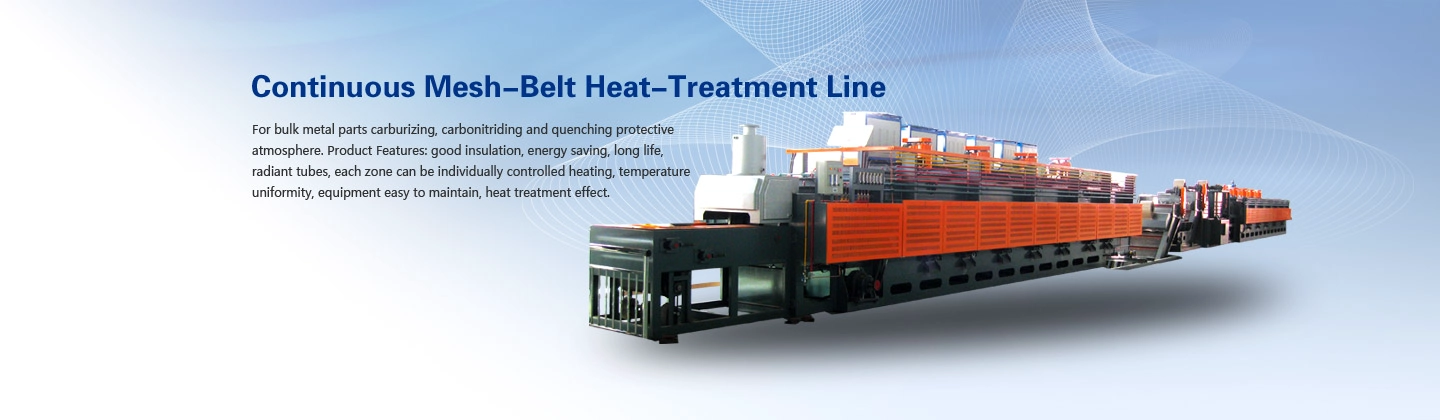
Heat treatment is the metallurgical process that decides final hardness, tensile strength, toughness and delayed fracture resistance of fasteners. Most high-strength fasteners adopt quenching and tempering treatment after cold heading. Inside the continuous mesh-belt furnace, parts are heated under controlled protective atmosphere, quenched rapidly and then tempered at a suitable temperature to transform martensite into tempered structure, balancing hardness and ductility while releasing internal stress from cold forming.
Traditional heat treatment equipment often suffers from high energy consumption, uneven temperature and unstable atmosphere control, which easily causes inconsistent hardness, decarburization and batch rejection. Modern energy-saving continuous heat treatment furnaces adopt closed-loop temperature control, precise atmosphere adjustment and optimized heat recycling structure. Compared with old Taiwan-style furnaces, they can reduce energy consumption obviously, maintain stable metallurgical results and lower long-run production cost for fastener factories.
Heat treatment quality directly affects fastener safety. Unqualified quenching or tempering will lead to brittle fracture under dynamic load. For fastener manufacturers, stable heat treatment is far more than a single process; it is the guarantee to pass ISO, SAE and other mechanical performance tests. At present, many leading fastener groups in India and Southeast Asia are upgrading their heat treatment lines, pursuing low energy consumption, continuous running and low maintenance, which makes reliable heat treatment furnaces one of the most valuable investments in the whole fastener plant.