














Application of Mesh Belt Heat Treatment Furnace in the Chain Industry
The chain industry serves as a fundamental supporting sector for mechanical transmission, covering automotive chains, motorcycle chains, industrial transmission chains, and precision miniature chains. Heat treatment is the core process that determines the mechanical performance, service life, and operational stability of chain products. Traditional batch heat treatment equipment features low automation, inconsistent temperature control, large workpiece deformation, and low production efficiency, which can no longer meet the high-standard and mass production demands of modern chain manufacturing. As a continuous and efficient thermal processing device, the mesh belt heat treatment furnace has become mainstream processing equipment in the chain industry by virtue of its stable performance, high automation, and uniform heat treatment effect.
1. Working Principle of Mesh Belt Heat Treatment Furnace
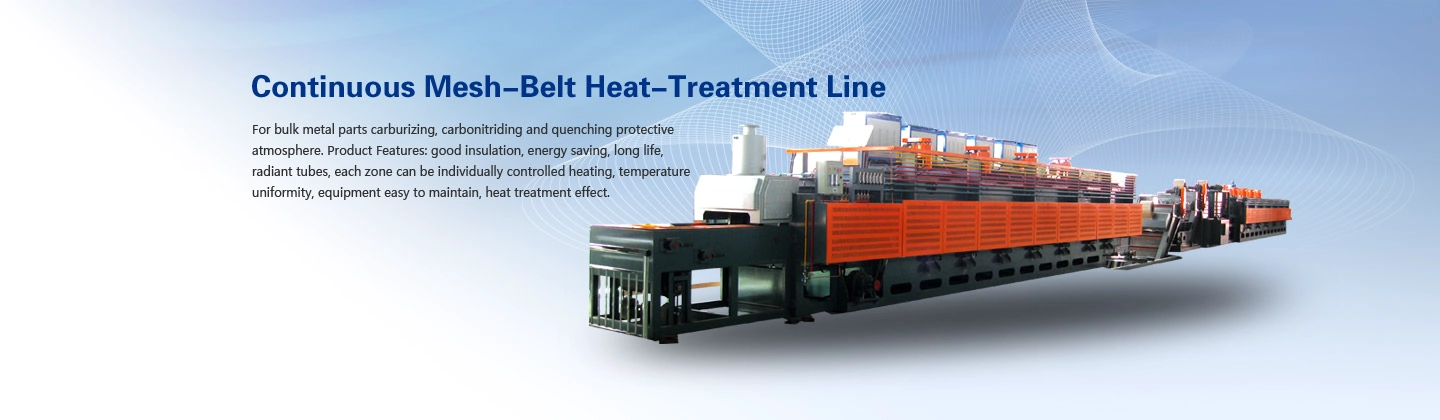
The mesh belt heat treatment furnace is a continuous tunnel-type heat treatment device equipped with a heat-resistant alloy mesh belt conveyor system. Relying on the stepless speed regulation of the mesh belt, chain workpieces are evenly and continuously transported through independent functional zones including the preheating zone, high-temperature heating zone, constant temperature soaking zone, and rapid cooling zone. The entire heat treatment process is completed in a fully enclosed atmosphere environment. Most advanced models are matched with nitrogen protection or ammonia decomposition atmosphere systems, which effectively prevent chain surfaces from oxidation, decarburization, and rusting during heating. With precise temperature control systems and uniform thermal field design, the equipment achieves consistent heating and cooling of each chain workpiece, realizing standardized and batch heat treatment processing.
2. Core Heat Treatment Processes for Chain Products
Chain parts such as chain plates, pins, rollers, and sleeves require strict heat treatment to balance hardness, toughness, and fatigue resistance. The mesh belt furnace can complete multiple key processes for chain manufacturing in one continuous production line.
First, quenching treatment. High-temperature quenching is performed on chain workpieces to rapidly improve surface hardness and wear resistance, enabling chains to withstand long-term friction and load impact during transmission. The uniform temperature field of the mesh belt furnace ensures consistent hardness of each batch of chain parts, avoiding local softness or insufficient hardness.
Second, tempering treatment. After quenching, low and medium-temperature tempering is conducted to eliminate internal quenching stress, effectively prevent workpiece cracking, and significantly enhance the toughness and impact resistance of chain products, ensuring stable operation under high-speed and heavy-load working conditions.
Third, carburizing and carbonitriding. For precision miniature chains and high-load industrial chains, the equipment supports low-temperature carburizing and carbonitriding processes to form a high-hardness and wear-resistant surface layer while maintaining a tough core structure, greatly extending the fatigue life of chains.
Fourth, stress relief annealing. It can eliminate stamping and machining residual stress of chain blanks, reduce product deformation, and improve the dimensional stability of finished chains.
3. Unique Advantages in Chain Industry Production
Continuous and high-efficiency mass production. Different from traditional box furnaces and trolley furnaces that rely on intermittent batch processing, the mesh belt furnace realizes 24-hour uninterrupted continuous production. The mesh belt conveying speed is adjustable, matching the beat of chain stamping and assembly production lines. It greatly improves production capacity, effectively solving the production bottleneck of large-volume chain processing and meeting the bulk order demands of the chain industry.
Stable product quality with low deformation. The equipment adopts a flat mesh belt bearing structure. Chain workpieces are placed flat and heated evenly without extrusion and collision during operation, effectively controlling thermal deformation. The fully enclosed protective atmosphere avoids surface oxidation and decarburization, ensuring smooth and bright workpiece surfaces, uniform hardness, and consistent mechanical properties of finished chains, with product qualification rate far higher than that of traditional processes.
High automation and low labor cost. The integrated production line integrates automatic feeding, constant temperature heating, precise cooling, and automatic discharging. The whole process requires minimal manual intervention. It realizes intelligent and streamlined heat treatment production, reduces manual operation errors, and greatly saves labor and management costs for enterprises.
Wide adaptability and strong flexibility. The mesh belt heat treatment furnace is suitable for all types of chain products, including heavy-duty industrial chains, automotive timing chains, bicycle chains, and precision miniature chains. By adjusting temperature parameters, belt speed, and atmosphere proportion, it can meet the diversified heat treatment process requirements of different materials and specifications of chain parts.
4. Industry Application Value and Development Prospects
With the rapid development of machinery manufacturing, automobile, logistics conveying, and intelligent equipment industries, the market has put forward higher requirements for the precision, durability, and stability of chain products. Traditional backward heat treatment processes can no longer adapt to the upgrading of the chain industry. As a mature and advanced continuous heat treatment equipment, the mesh belt heat treatment furnace helps chain manufacturing enterprises achieve standardized production, stable product quality, and efficient cost control.
In the future, with the continuous upgrading of industrial intelligent manufacturing, mesh belt heat treatment furnaces will develop towards higher precision, intelligent temperature control, energy conservation and environmental protection, and ultra-high efficiency. It will continue to empower the high-quality development of the global chain manufacturing industry and become an indispensable core equipment in the chain production process.