














Basic Knowledge of Fastener Heat Treatment Furnace
Fastener heat treatment furnaces are core industrial thermal processing equipment specially designed for heat treatment of bolts, nuts, screws, studs and other metal fasteners. As an indispensable part of the fastener manufacturing chain, this equipment fundamentally improves the mechanical properties of metal fasteners through precise high-temperature heating, constant-temperature holding and controlled cooling processes, solving common defects of raw materials such as low hardness, poor toughness, uneven internal stress and unstable wear resistance. In high-end fields including automotive manufacturing, aerospace, mechanical engineering and construction engineering, qualified heat treatment via professional furnaces is the primary guarantee for fastener service life and operational safety.
The core value of fastener heat treatment furnaces lies in changing the internal metallographic structure of carbon steel, alloy steel and stainless steel fasteners without altering their external dimensions and shapes. Different from ordinary industrial heating furnaces, fastener-specific heat treatment furnaces feature strict temperature uniformity, stable atmosphere control and continuous processing capacity, which are tailored to the batch production and precision performance requirements of standard fasteners. Ordinary heating equipment can only achieve surface heating, while professional fastener heat treatment furnaces realize consistent internal and external structural improvement, ensuring uniform hardness, tensile strength and fatigue resistance of each fastener in batch production.
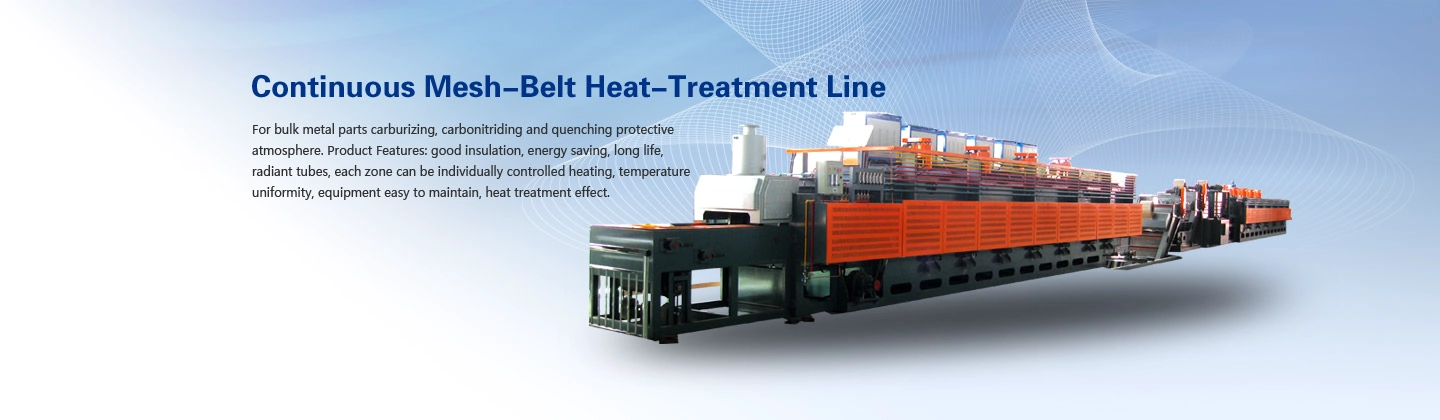
According to structural form and production mode, fastener heat treatment furnaces are mainly divided into continuous mesh belt furnaces, roller hearth furnaces, box-type batch furnaces and pusher furnaces. Among them, continuous mesh belt furnaces are the most widely used in the industry, suitable for mass production of small and medium-sized fasteners such as standard screws and ordinary bolts. They support uninterrupted feeding, heating, quenching and tempering, with high production efficiency and stable product consistency. Roller hearth furnaces are applicable to large-size and high-strength fasteners such as high-tensile studs and heavy-duty bolts, featuring strong load-bearing capacity and uniform heating. Box-type batch furnaces are mostly used for small-batch, multi-variety customized fastener processing, with flexible operation and wide process adaptability. Pusher furnaces are favored for high-precision aerospace fasteners due to their sealed heating environment and precise atmosphere control.
In terms of heat treatment processes covered, standard fastener furnace systems complete four core processes: annealing, normalizing, quenching and tempering. Annealing is mainly used to soften raw fastener blanks, eliminate internal stress generated during stamping and threading, and improve material machinability. Normalizing refines grain structure, uniformizes material properties and lays a foundation for subsequent strengthening treatment. Quenching is the key hardening process, which rapidly cools high-temperature fasteners to obtain high hardness and strength. Tempering is a follow-up optimization process to reduce quenching brittleness, balance hardness and toughness, and avoid fastener fracture during service.
Modern fastener heat treatment furnaces are composed of multiple core systems, including heating system, temperature control system, atmosphere protection system, transmission system and cooling system. The heating system adopts electric heating or gas heating modes; electric heating features clean energy and precise temperature control, while gas heating has low operating cost and high heating efficiency. The intelligent temperature control system supports multi-zone temperature regulation, with temperature accuracy controlled within ±5℃, meeting the strict process requirements of high-strength fasteners. The atmosphere protection system fills the furnace with nitrogen, methanol and other protective gases to prevent fastener surface oxidation, decarburization and rusting, ensuring smooth surface and stable performance of finished products.
With the upgrading of industrial manufacturing, fastener heat treatment furnaces are developing towards intelligence, energy conservation and environmental protection. Traditional furnaces have high energy consumption and large temperature fluctuation, while new fiber-lined furnaces have low heat capacity, small heat loss and fast temperature rise and fall, greatly reducing energy consumption. Equipped with PLC intelligent control modules, modern equipment can automatically adjust heating temperature, holding time and transmission speed according to fastener specifications and material types, realizing unmanned batch production. Mastering the basic knowledge of fastener heat treatment furnaces is the premise for standardized equipment operation, process optimization and product quality control, and is crucial for improving the overall qualification rate of fastener products and reducing production costs.