














Working Principle of Fastener Heat Treatment Furnace
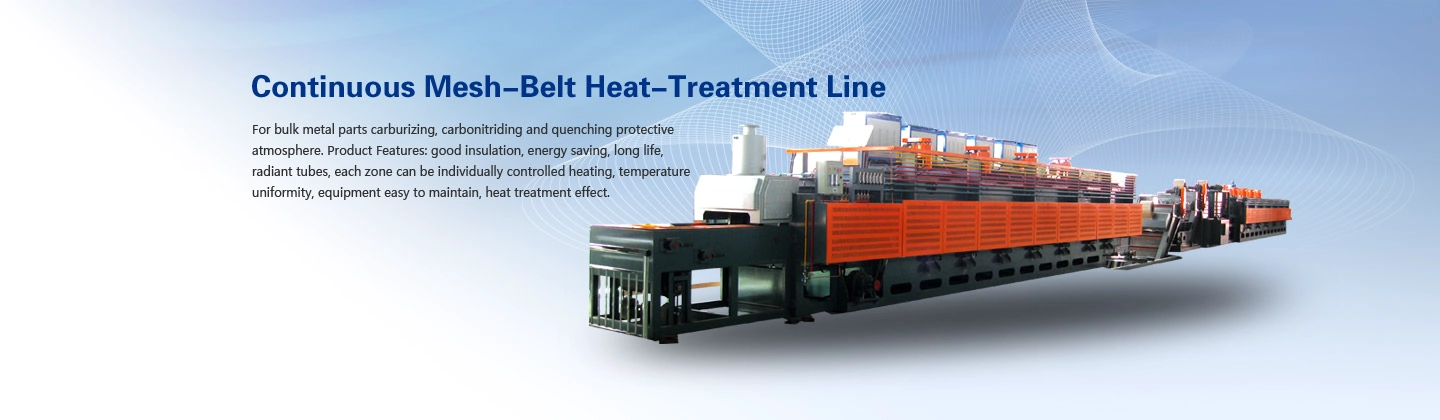
The working principle of a fastener heat treatment furnace is based on metal material thermodynamics and metallographic phase transformation theory, realizing directional optimization of fastener mechanical properties through closed-loop control of heating, heat preservation, atmosphere protection, transmission and rapid cooling. The entire working process is a continuous and systematic physical and chemical reaction process, which accurately controls the temperature, time and environmental atmosphere of fasteners in different processing stages to complete structural transformation and performance upgrading. Taking the most widely used continuous mesh belt heat treatment furnace as the main model, its working principle can be divided into five core links: feeding transmission, gradient heating, constant-temperature atmosphere protection, precise quenching and low-temperature tempering.
The first core link is continuous feeding and stable transmission. Fasteners are evenly arranged on the high-temperature resistant mesh belt through an automatic feeding machine, avoiding stacking and overlapping to ensure uniform heating of each workpiece. The mesh belt is driven by a variable-frequency motor, and the transmission speed can be precisely adjusted according to fastener size, material hardness requirements and process parameters. The stable transmission system ensures that fasteners pass through the preheating zone, high-temperature heating zone, constant-temperature holding zone, quenching zone and tempering zone in sequence at a fixed speed, realizing standardized and streamlined production. The variable-frequency speed regulation technology effectively avoids workpiece jitter and offset, ensuring consistent processing time for each batch of fasteners.
The second link is gradient heating and heat conduction. The furnace body is divided into multiple independent temperature control zones, including preheating zone, high-temperature austenitizing zone and uniform temperature holding zone. The preheating zone slowly raises the fastener temperature to eliminate the temperature difference inside and outside the workpiece, preventing workpiece deformation and cracking caused by rapid high-temperature heating. The high-temperature heating zone heats carbon steel and alloy steel fasteners to 840℃-880℃ (adjustable according to carbon content), enabling the internal ferrite and pearlite structures to be completely transformed into uniform austenite structures. The constant-temperature holding zone maintains the set high temperature for 15-30 minutes to ensure full penetration of heat, complete internal structural transformation and eliminate structural differences caused by fastener thread gaps and uneven wall thickness.
The third core principle is sealed atmosphere protection. In the high-temperature heating state, steel fasteners are prone to oxidation and decarburization when contacting air, resulting in reduced surface hardness and poor thread precision. The furnace adopts a fully sealed structural design, and the atmosphere system continuously injects mixed protective gas of nitrogen and methanol into the furnace cavity. The protective gas forms a stable inert environment to isolate oxygen, effectively preventing fastener surface oxidation, decarburization and rusting. Meanwhile, the intelligent atmosphere detector monitors the gas concentration and pressure in real time, automatically supplements gas and adjusts flow rate to maintain the stability of the furnace environment, ensuring the surface finish and structural consistency of heat-treated fasteners.
The fourth key link is precise quenching and rapid cooling. After high-temperature austenitizing and heat preservation, fasteners are transmitted to the quenching tank along with the mesh belt for rapid cooling. According to different material characteristics, the quenching medium is selected as quenching oil, polymer solution or clean water. High-carbon steel fasteners adopt oil quenching to avoid excessive cooling speed causing brittle fracture, while low-carbon steel fasteners use water quenching to improve hardness. The rapid cooling process instantly fixes the high-temperature austenite structure into dense martensite structure, greatly improving the hardness, tensile strength and wear resistance of fasteners. The quenching tank is equipped with a circulating cooling system to keep the temperature of the quenching medium stable and avoid uneven cooling effect caused by temperature rise.
The final link is low-temperature tempering and stress relief. Quenched fasteners have high hardness but large internal residual stress and strong brittleness. The tempering zone heats the fasteners to 400℃-600℃ for constant-temperature holding and slow cooling. This process decomposes part of the martensite structure, releases internal quenching stress, reduces material brittleness, and balances the hardness and toughness of fasteners. After tempering, the fasteners have excellent comprehensive mechanical properties, which can resist fatigue damage and impact load during long-term service.
In general, the working principle of the fastener heat treatment furnace is to rely on multi-zone precise temperature control, sealed atmosphere protection and standardized transmission cooling process to induce controllable metallographic phase transformation of metal materials. All links are coordinated by the PLC intelligent control system to realize automatic operation, ensuring that each batch of fasteners achieves stable and consistent heat treatment effects, which is the core guarantee for mass production of high-quality standard fasteners.