














Comparison Between Trolley Furnace and Mesh Belt Furnace
Comparison Between Trolley Furnace and Mesh Belt Furnace
In the field of industrial heat treatment, trolley furnaces and mesh belt furnaces are two widely used types of equipment, each with unique structural characteristics, working principles and application scenarios. Understanding their differences is crucial for enterprises to select the most suitable heat treatment equipment, improve production efficiency and ensure product quality. This article will conduct a comprehensive comparison of trolley furnaces and mesh belt furnaces from multiple dimensions, helping readers clarify their advantages, disadvantages and applicable scope.
1. Structural Differences
1.1 Trolley Furnace
A trolley furnace is a kind of batch-type heat treatment furnace, whose core structure consists of a furnace body, a trolley, a heating system, a ventilation system and a control system. The furnace body is a closed or semi-closed structure made of high-temperature resistant materials, which is used to maintain the high-temperature environment required for heat treatment. The trolley is the key component for placing workpieces; it can move freely inside and outside the furnace body through rails. When loading and unloading workpieces, the trolley is pulled out of the furnace, and after the workpieces are placed, the trolley is pushed into the furnace for sealing and heating. The heating elements are usually arranged on the inner wall of the furnace body (such as the top, side walls and bottom), ensuring uniform heating of the workpieces in the furnace. In addition, the trolley furnace is equipped with a reliable sealing device to prevent heat loss and ensure the stability of the furnace temperature.
1.2 Mesh Belt Furnace
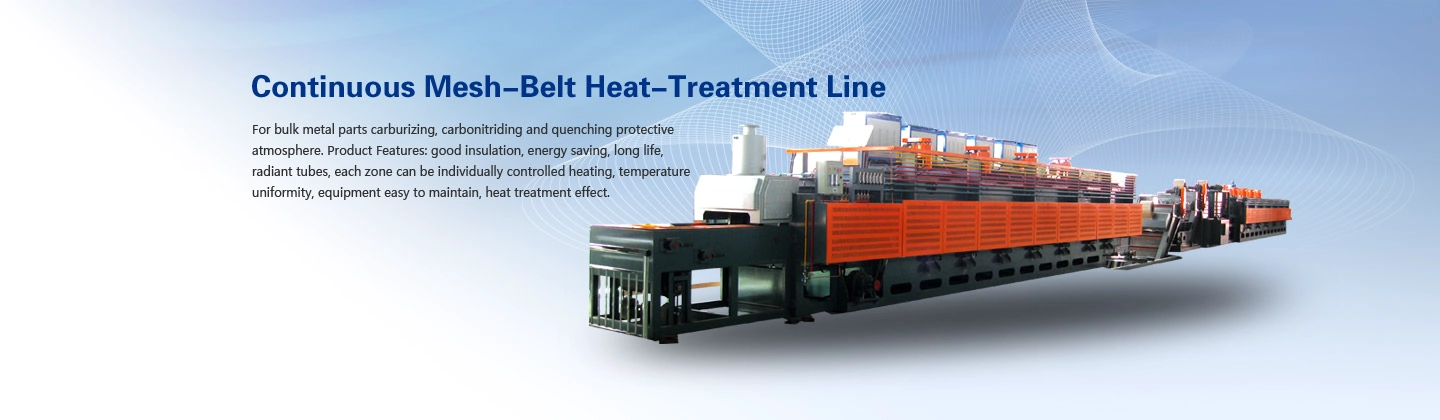
Unlike the trolley furnace, the mesh belt furnace is a continuous-type heat treatment furnace, and its main structure includes a furnace body, a mesh belt conveying system, a heating system, a cooling system and an electrical control system. The furnace body is a long strip structure, and the inside is divided into different temperature zones (such as preheating zone, heating zone, heat preservation zone and cooling zone) according to the heat treatment process requirements. The mesh belt conveying system is composed of a mesh belt, a driving device and a tensioning device; the mesh belt is made of high-temperature resistant alloy materials, and the workpieces are placed on the mesh belt and move continuously through each temperature zone with the operation of the mesh belt, realizing continuous loading, heat treatment and unloading. The heating elements are evenly arranged in each temperature zone, and the temperature of each zone can be independently controlled to meet the process requirements of different workpieces.
2. Differences in Working Principles
2.1 Trolley Furnace
The trolley furnace adopts a batch-type operation mode. The working process is roughly as follows: first, pull the trolley out of the furnace, place the workpieces to be heat-treated on the trolley in an orderly manner, and ensure that the workpieces are evenly distributed to avoid uneven heating. Then, push the trolley into the furnace body and seal the furnace door tightly to prevent cold air from entering and heat from escaping. Next, start the heating system, and the heating elements heat the inside of the furnace to the set temperature. During the heating process, the ventilation system continuously circulates the air in the furnace to make the furnace temperature uniform. After the heat treatment process (such as annealing, normalizing, quenching) is completed, the heating system is turned off, and the workpieces are cooled to an appropriate temperature in the furnace (or cooled by air cooling, water cooling, etc. according to requirements) before the trolley is pulled out to unload the workpieces. The entire process is intermittent, and each batch of workpieces needs to go through the whole process of loading, heating, heat preservation and unloading.
2.2 Mesh Belt Furnace
The mesh belt furnace adopts a continuous operation mode, and its working principle is based on the continuous conveying of the mesh belt. The workpieces are continuously placed on the mesh belt at the feeding end of the furnace, and the mesh belt drives the workpieces to move at a constant speed through each temperature zone in the furnace. In the preheating zone, the workpieces are gradually heated to avoid thermal stress caused by sudden heating; in the heating zone, the workpieces are heated to the required heat treatment temperature; in the heat preservation zone, the workpieces are kept at a constant temperature to ensure that the internal structure of the workpieces is fully transformed; finally, the workpieces enter the cooling zone to cool down to the required temperature, and then are continuously unloaded at the discharge end. The entire heat treatment process is carried out continuously, and there is no need to stop the furnace for loading and unloading, which realizes the automation and continuity of production.
3. Differences in Application Scenarios
3.1 Trolley Furnace
Due to its batch-type operation mode and large furnace space, the trolley furnace is particularly suitable for heat treatment of large, heavy or irregularly shaped workpieces. Common application scenarios include: heat treatment of large castings, forgings, steel plates, steel pipes, and large mechanical parts (such as gears, shafts, and brackets). In addition, the trolley furnace has strong flexibility and can adjust the heat treatment process (temperature, heat preservation time, etc.) according to the needs of different batches of workpieces, which is suitable for small-batch, multi-variety production. For example, in the machinery manufacturing industry, the trolley furnace is often used for annealing, normalizing and quenching of large parts, which can ensure the mechanical properties of the parts.
3.2 Mesh Belt Furnace
The mesh belt furnace is suitable for continuous heat treatment of small and medium-sized, regular-shaped workpieces due to its continuous operation characteristics. Common application scenarios include: heat treatment of small hardware, auto parts (such as bolts, nuts, gears), electronic components, springs, and metal wires. It is widely used in industries such as automobile manufacturing, hardware processing, electronic equipment, and precision machinery. The mesh belt furnace has high production efficiency, can realize mass production, and the heat treatment process is stable and uniform, which is suitable for large-batch, single-variety production. For example, in the auto parts industry, a large number of bolts and nuts need to be heat-treated, and the mesh belt furnace can complete the continuous heat treatment of the workpieces, greatly improving production efficiency.
4. Advantages and Disadvantages Comparison
4.1 Advantages and Disadvantages of Trolley Furnace
Advantages: First, it has strong adaptability to workpieces, and can handle large, heavy and irregular workpieces that are difficult to be conveyed by the mesh belt. Second, the flexibility is high, and the heat treatment process can be flexibly adjusted according to the characteristics of different workpieces and batches. Third, the furnace space is large, and a large number of workpieces can be processed in each batch, which is suitable for small-batch and multi-variety production. Fourth, the structure is relatively simple, the maintenance is convenient, and the investment cost is relatively low compared with large-scale continuous equipment.
Disadvantages: First, the operation is intermittent, the loading and unloading process takes a long time, and the production efficiency is relatively low, which is not suitable for large-batch continuous production. Second, the labor intensity of loading and unloading is high, and manual operation or auxiliary equipment is usually required, which increases the labor cost. Third, due to the frequent opening and closing of the furnace door, the heat loss is large, the energy consumption is relatively high, and the temperature stability in the furnace is easily affected during the loading and unloading process.
4.2 Advantages and Disadvantages of Mesh Belt Furnace
Advantages: First, the production efficiency is high, the continuous operation mode realizes automatic loading and unloading, which greatly shortens the production cycle and is suitable for large-batch mass production. Second, the heat treatment process is stable and uniform, the temperature of each zone is accurately controlled, and the consistency of the workpiece quality is good. Third, the labor intensity is low, the automation degree is high, and the number of operators can be reduced, which saves labor costs. Fourth, the heat loss is small, the energy utilization rate is high, and the long-term operation can save energy consumption.
Disadvantages: First, the adaptability to workpieces is poor, and it is difficult to process large, heavy or irregularly shaped workpieces, which is only suitable for small and medium-sized regular workpieces. Second, the structure is complex, especially the mesh belt conveying system is easy to wear and needs regular maintenance and replacement, which increases the maintenance cost. Third, the investment cost is relatively high, which is not suitable for small enterprises with small production scale and limited funds. Fourth, the flexibility is poor, and it is difficult to adjust the process quickly when replacing the type of workpiece, which is suitable for single-variety large-batch production.
5. Selection Suggestions
When selecting between a trolley furnace and a mesh belt furnace, enterprises should comprehensively consider the following factors: workpiece size, shape, production batch, heat treatment process requirements, investment budget and production efficiency requirements.
If the enterprise mainly processes large, heavy or irregularly shaped workpieces, and the production batch is small and the variety is large, the trolley furnace is a more suitable choice. It can meet the flexible processing needs of different workpieces, and the investment cost is relatively low, which is suitable for small and medium-sized enterprises with diverse production needs.
If the enterprise mainly processes small and medium-sized regular workpieces, and the production batch is large, and it is necessary to improve production efficiency and ensure the consistency of workpiece quality, the mesh belt furnace is more appropriate. Although its initial investment and maintenance cost are relatively high, it can save labor costs and energy consumption in the long run, and is suitable for large-scale continuous production enterprises.
6. Conclusion
Trolley furnaces and mesh belt furnaces are important equipment in industrial heat treatment, each with its own unique advantages and applicable scenarios. The trolley furnace is flexible and adaptable, suitable for small-batch, multi-variety and large workpiece processing; the mesh belt furnace is efficient and stable, suitable for large-batch, single-variety and small-medium workpiece continuous processing. Enterprises should choose the appropriate equipment according to their own actual production needs, so as to maximize production efficiency, reduce costs and ensure product quality. With the continuous development of heat treatment technology, both types of furnaces are constantly being upgraded and improved, bringing more possibilities for the development of the industrial manufacturing industry.