















Continuous Mesh Belt Furnace Technology: Detailed Design, Working Principle and Applications
The continuous mesh belt furnace is one of the most mature and widely used continuous industrial furnaces in the modern heat treatment industry. This article systematically explains its structure, principles, control methods and applicable scenarios from a technical perspective, helping equipment purchasers, process engineers and workshop managers understand the equipment fundamentally and make more scientific decisions.
Overall Structural Design
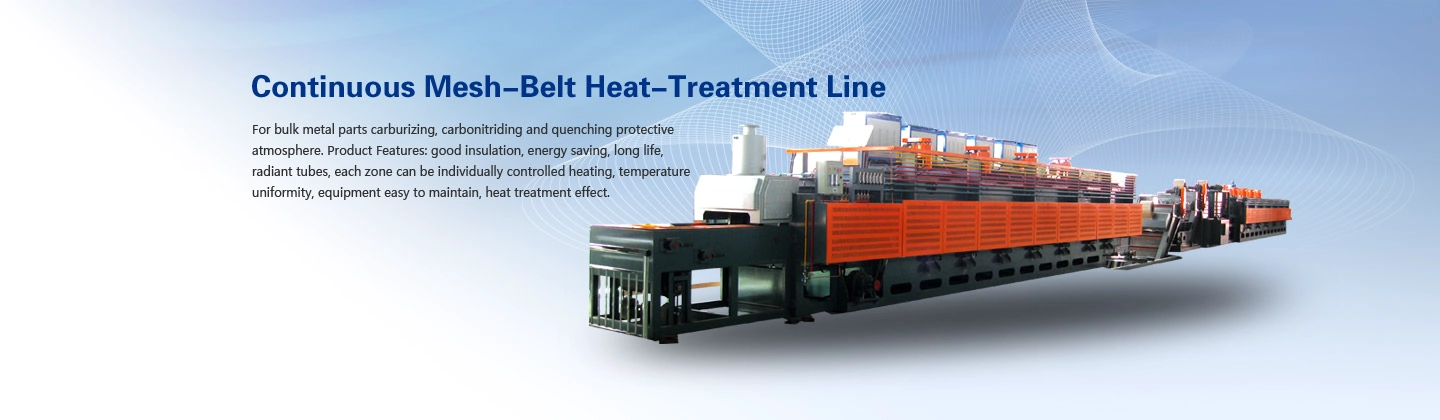
A typical continuous mesh belt furnace production line consists of eight core components: feeding mechanism, preheating zone, high-temperature process zone (carburizing/quenching, etc.), quenching tank, optional cleaning machine, tempering furnace, discharge and cooling system, and atmosphere, electrical, control and cooling circulation systems. The modular design allows for flexible configuration according to production needs, from basic manual loading systems to fully automated production lines with MES integration.
Thermal Working Principle
The furnace adopts two main heating methods: electric heating (radiation tubes and resistance belts) for precise temperature control, and gas heating for low operating costs in large-capacity production. Heat transfer is primarily through radiation and convection, ensuring uniform heating of workpieces on the mesh belt and high temperature consistency across the processing zone. The insulation layer made of high-temperature ceramic fiber minimizes heat loss, improving thermal efficiency and reducing energy consumption.
Atmosphere Control Principle
The protective atmosphere in the furnace serves three core functions: preventing oxidation and decarburization, enabling carburizing and carbonitriding processes, and ensuring bright surface quality of workpieces. The control system relies on oxygen probes, carbon potential controllers, dew point meters and flow meters to maintain stable atmosphere composition. For carburizing processes, real-time carbon potential monitoring ensures precise carbon layer depth, while nitrogen-based atmospheres are used for non-carburizing processes to avoid surface contamination.
Applicable Materials and Workpieces
Continuous mesh belt furnaces are suitable for a wide range of materials, including carbon steel, alloy steel and stainless steel. They are ideal for processing small and medium-sized workpieces with high production volume, such as standard fasteners, special-shaped parts, small-modulus gears, pins, shafts, chains, bearing rollers and stamping parts. The linear conveying design is particularly suitable for long, strip-shaped and small-sized parts, ensuring stable processing and minimal deformation.
Technical Advantages Summary
The continuous mesh belt furnace boasts a series of core technical advantages: continuous production for high efficiency, precise control of temperature and atmosphere for consistent product quality, high automation with minimal manual intervention, small workpiece deformation and good surface quality, and suitability for large-scale and standardized production. These advantages make it the preferred equipment for mass heat treatment in the fastener and automotive parts industries.
Conclusion
From a technical perspective, the continuous mesh belt furnace integrates mechanical design, thermal engineering, atmosphere control and automation technology, forming a complete set of efficient heat treatment solutions. By understanding its structural design, working principles and applicable scope, manufacturers can better utilize its advantages, optimize production processes and meet the growing demand for high-quality fastener products.