














How to Select the Right Continuous Mesh Belt Furnace for Fastener Production Lines
For fastener enterprises, purchasing a continuous mesh belt furnace is an important investment. Choosing the wrong equipment will lead to insufficient production capacity, high energy consumption, unqualified products and troublesome maintenance. This article provides a directly usable selection logic to help you quickly determine the most suitable equipment.
Core Selection Questions
Before starting the selection process, enterprises must clarify four core questions: the main product types (standard parts, automotive parts, special-shaped parts, stainless steel parts), annual output and target hourly production capacity (kg/h), necessary heat treatment processes (quenching, carburizing, carbonitriding, annealing, tempering), and workshop conditions (power capacity, gas supply, site area, environmental requirements). These questions form the basis for all subsequent selection decisions.
Key Selection Dimensions
Mesh Belt Width
The belt width determines the single loading capacity of the furnace. Small parts commonly use 400-600mm wide belts, while high-volume production requires 800-1200mm wide belts to maximize production efficiency. The width should be matched with the size and stacking mode of the processed parts to avoid waste of loading space.
Heating Method
Electric heating is suitable for small and medium-sized furnaces and high-precision products due to its precise temperature control and low investment cost. Gas heating is more cost-effective for large-capacity and long-term high-load production, with lower operating costs and higher thermal efficiency for large-scale production lines.
Atmosphere System
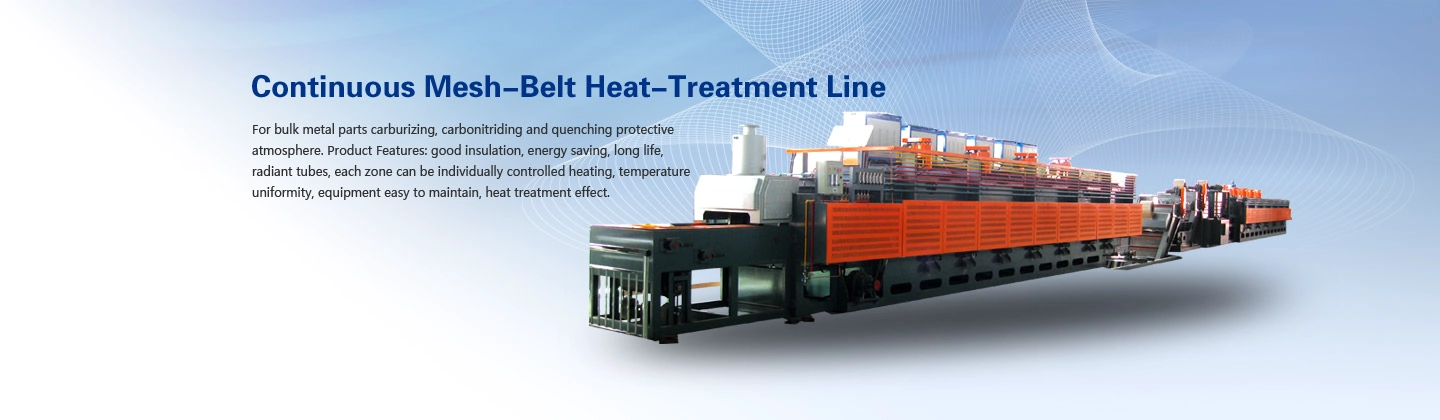
The atmosphere system is selected according to process requirements: nitrogen-based atmosphere is sufficient for quenching and annealing processes, endothermic gas or methanol+acetone is required for carburizing and carbonitriding, and ammonia decomposition atmosphere is used for high-brightness surface requirements. The selection directly affects the surface quality and mechanical properties of the processed parts.
Automation Level
The automation level is divided into three grades: basic type with manual loading and instrument control, standard type with PLC recipe and alarm functions, and high-end type with networking, remote monitoring, data upload and MES docking. Higher automation reduces labor costs and human error, but requires a higher initial investment.
Supplier Evaluation Criteria
When selecting a supplier, enterprises should evaluate the supplier’s industry experience (especially in fastener manufacturing), the service life of furnace liners and mesh belts, the maturity of control solutions, after-sales response speed, and word-of-mouth from actual cases. Suppliers with rich experience in fastener heat treatment can provide more targeted design and after-sales services, reducing later operation risks.
Final Selection Formula
The most suitable continuous mesh belt furnace is the one that meets process requirements, achieves production capacity targets, has reasonable energy consumption, matches the budget, and has reliable after-sales service. Enterprises should avoid pursuing excessive configuration or blindly reducing costs, and balance performance, cost and reliability to select equipment that is most suitable for long-term development.
Conclusion
Selecting a continuous mesh belt furnace is a systematic project that requires comprehensive consideration of production, process, cost and after-sales factors. By clarifying core needs, comparing key dimensions, evaluating suppliers and following the selection logic, enterprises can purchase equipment that not only meets current production needs but also supports future capacity expansion, laying a solid foundation for the development of the fastener production line.