














Development Status, Market Trends and Future Prospects of the Global Mesh Belt Furnace Heat Treatment Industry
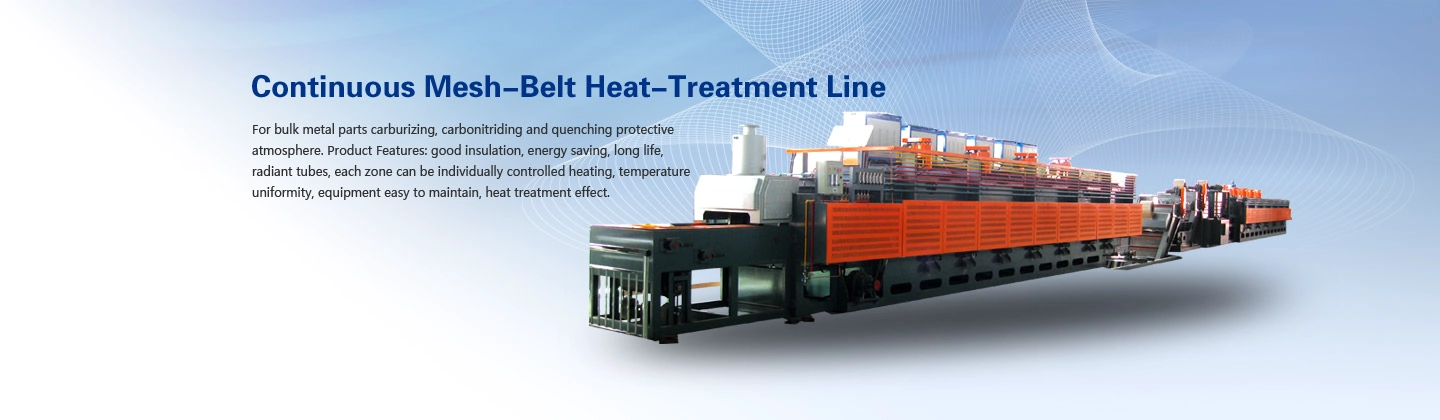
The global mesh belt furnace heat treatment industry has maintained steady development in recent years, driven by the booming downstream precision manufacturing, automotive, electronic and powder metallurgy industries. As a key equipment for continuous and efficient industrial heat treatment, mesh belt furnaces have replaced a large number of traditional intermittent heat treatment equipment and become the mainstream choice for medium and large-scale production enterprises, forming a complete industrial chain covering equipment R&D, manufacturing, sales and after-sales service.
At present, the industry presents obvious regional development characteristics. Developed regions such as Europe, America and Japan started early in mesh belt furnace technology research and development, with mature manufacturing processes, stable product performance and rich technical accumulation, occupying the high-end market of global precision heat treatment equipment. China, Southeast Asia and other emerging manufacturing regions have become the main growth markets of the industry. Benefiting from the rapid expansion of local downstream manufacturing industries, the market demand for cost-effective, high-efficiency and energy-saving mesh belt furnaces continues to rise. Meanwhile, local equipment manufacturers are constantly improving independent R&D capabilities, narrowing the technical gap with international advanced level and gradually realizing import substitution of medium and low-end equipment and breakthroughs in high-end equipment technology.
The downstream market demand upgrade is the core driving force for the iterative development of the mesh belt furnace heat treatment industry. The global automotive industry’s transformation towards electrification and lightweight has put forward higher requirements for heat treatment processing. New energy vehicles require a large number of lightweight alloy parts and high-strength steel structural parts, which need precise mesh belt furnace heat treatment processes such as stress relief annealing and high-strength quenching to ensure product safety and durability. In addition, the rapid development of consumer electronics, precision hardware and aerospace precision component manufacturing industries has further increased the market demand for high-precision, low-deformation and high-consistency heat treatment equipment.
Energy conservation, environmental protection and intellectualization have become the core development trends of the industry. In terms of environmental protection, with the continuous improvement of global industrial environmental protection standards, traditional high-energy-consumption and high-pollution heat treatment equipment is being phased out. New mesh belt furnaces adopt energy-saving heating elements, heat recovery systems and flue gas purification devices, which effectively reduce energy consumption and pollutant emissions, meeting green production requirements. In terms of intellectualization, modern mesh belt furnace systems are integrated with PLC intelligent control, real-time temperature monitoring, automatic fault alarm and production data statistics functions, realizing full-process automated production and intelligent management, which greatly improves production management efficiency and product yield.
Looking forward to the future, the mesh belt furnace heat treatment industry will continue to develop in the direction of high precision, high efficiency, intelligence and green environmental protection. With the continuous upgrading of global manufacturing industry and the expansion of emerging application scenarios such as new energy equipment and intelligent hardware, the market scale of mesh belt furnace heat treatment equipment will continue to expand. At the same time, technological innovation will further promote equipment performance optimization, personalized customized equipment for segmented industries will become a new growth point of the market, and the industry will usher in more high-quality development opportunities.