














Principles, Core Advantages and Industrial Applications of Mesh Belt Furnace Heat Treatment Technology
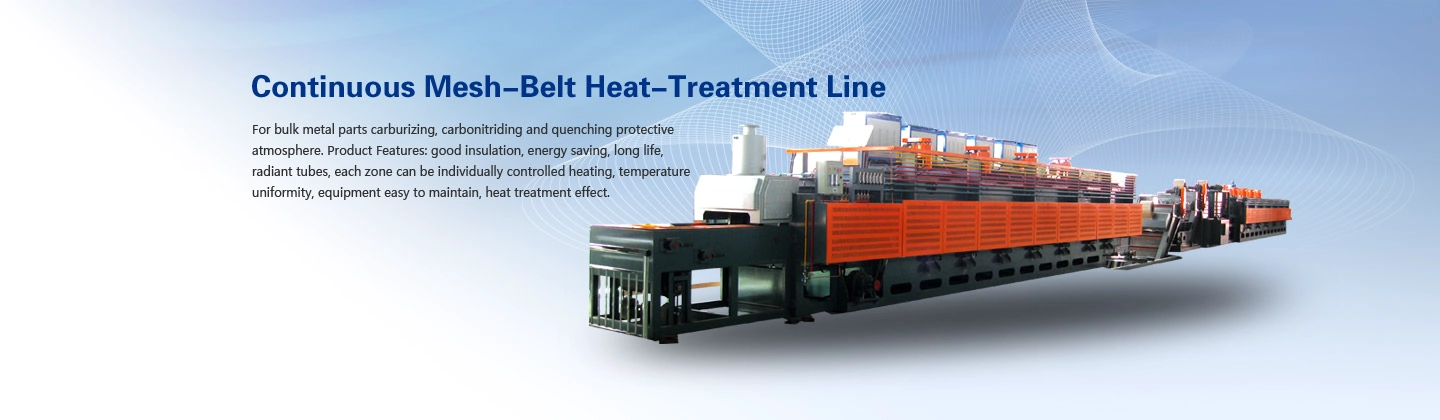
As a mainstream continuous heat treatment equipment in modern industrial manufacturing, the mesh belt furnace has become an indispensable core facility for mass precision thermal processing of metal and non-metal components. Different from traditional batch-type furnaces that rely on intermittent feeding and discharging, the mesh belt furnace adopts a heat-resistant metal mesh belt conveyor system to realize fully automated, uninterrupted production workflows. It can steadily deliver workpieces through preheating, constant-temperature soaking, high-temperature heating, controlled cooling and other functional zones, achieving standardized and unified heat treatment effects for each batch of products.
The complete operation system of a mesh belt furnace consists of five core modules: mesh belt transmission system, intelligent heating system, precise temperature control system, circulating cooling system and flue gas exhaust purification system. All modules operate in a coordinated manner to solve the common pain points of traditional heat treatment processes, such as uneven heating, unstable product quality and low production efficiency. The unique mesh belt structure enables hot air and heat radiation to fully circulate around workpieces, eliminating local overheating or insufficient heating, and ensuring excellent temperature uniformity throughout the processing zone.
This heat treatment technology boasts prominent industrial advantages. First, it supports high-volume continuous production, with stable hourly output suitable for large-scale industrial manufacturing, greatly improving production efficiency compared with traditional equipment. Second, the intelligent temperature control system realizes accurate temperature adjustment within a small error range, ensuring consistent mechanical properties of processed workpieces, including uniform hardness, stable fatigue resistance and reliable structural strength. Third, the automated operation mode reduces manual intervention, lowers labor costs and avoids quality fluctuations caused by human operation errors. In addition, modern mesh belt furnaces are equipped with energy-saving structures and environmental protection devices, which effectively reduce energy consumption and meet industrial environmental protection production standards.
Mesh belt furnace heat treatment technology is widely applied in multiple downstream industries. In the fastener manufacturing industry, it is used for quenching and tempering treatment of bolts, screws, rivets and studs to enhance their wear resistance and structural stability. In the automotive industry, it processes precision parts such as small gears, springs, bearings and transmission components, providing reliable performance guarantees for automotive mechanical systems. In the electronic components industry, it completes annealing and brazing of precision hardware pins and conductive terminals to ensure stable electrical conductivity and dimensional accuracy. Moreover, it is also extensively used in powder metallurgy sintering, hardware tool processing and non-ferrous metal thermal treatment fields, covering most medium and small-sized precision component processing scenarios.
With the upgrading of industrial manufacturing towards precision and intelligence, mesh belt furnace heat treatment technology is also iterating continuously. Intelligent monitoring, remote parameter adjustment and full-process data tracing functions have been gradually popularized, further improving the precision, stability and intelligence level of industrial heat treatment production, and laying a solid foundation for high-quality development of the precision manufacturing industry.