














Technological Evolution & Future Trends of Mesh Belt Furnaces in Fastener Manufacturing
Introduction
The fastener industry has undergone a remarkable transformation over the past 20 years, driven by escalating quality standards, cost pressures, and the demand for high-volume, consistent production. Two decades ago, fastener heat treatment relied on outdated, low-capacity equipment—shaker hearth furnaces, rotary hearth furnaces, and plate belt systems—that suffered from inconsistent heating, high labor costs, and frequent part damage. Today, these obsolete technologies have been almost entirely replaced by modern mesh belt furnaces, which have evolved from basic continuous heaters into smart, energy-efficient, and highly precise production systems tailored to the unique needs of fastener manufacturing.
This article explores the technological evolution of mesh belt furnaces for fasteners, highlighting key advancements in design, process control, and automation. It also examines the future trends shaping the industry—from IoT-enabled smart manufacturing and green energy integration to advanced tempering systems and inline quality control—revealing how mesh belt furnaces will continue to drive innovation in fastener production.
From Batch to Continuous: The Early Evolution of Mesh Belt Furnaces
The first mesh belt furnaces for fasteners emerged in the 1980s, designed to address the critical limitations of batch processing. Early models were simple, semi-automated systems with basic temperature control (±10–15°C), fixed-speed mesh belts, and minimal atmosphere regulation. While a significant improvement over batch furnaces, these early mesh belt systems suffered from three major flaws that limited their performance:
- Poor Temperature Uniformity: Single-zone heating and inadequate airflow circulation created hot and cold spots, leading to inconsistent hardness and warped fasteners.
- Unreliable Atmosphere Control: Manual gas flow regulation and lack of carbon potential monitoring resulted in surface oxidation and decarburization, reducing fastener durability.
- Limited Automation: Manual loading/unloading and frequent operator intervention increased labor costs and human error, making it difficult to scale production.
Despite these limitations, early mesh belt furnaces proved the transformative potential of continuous processing for fasteners, laying the groundwork for the technological advancements that followed in the 1990s and 2000s.
Key Technological Advancements (2000–2025)
The past 25 years have witnessed revolutionary advancements in mesh belt furnace technology, driven by the fastener industry’s demand for higher quality, lower costs, and greater efficiency. These advancements have transformed mesh belt furnaces from basic heaters into precision manufacturing systems capable of meeting the strictest global quality standards.
1. Precision Temperature & Atmosphere Control
The most critical advancement has been the development of multi-zone temperature control and closed-loop atmosphere regulation, addressing the early flaw of inconsistent heating.
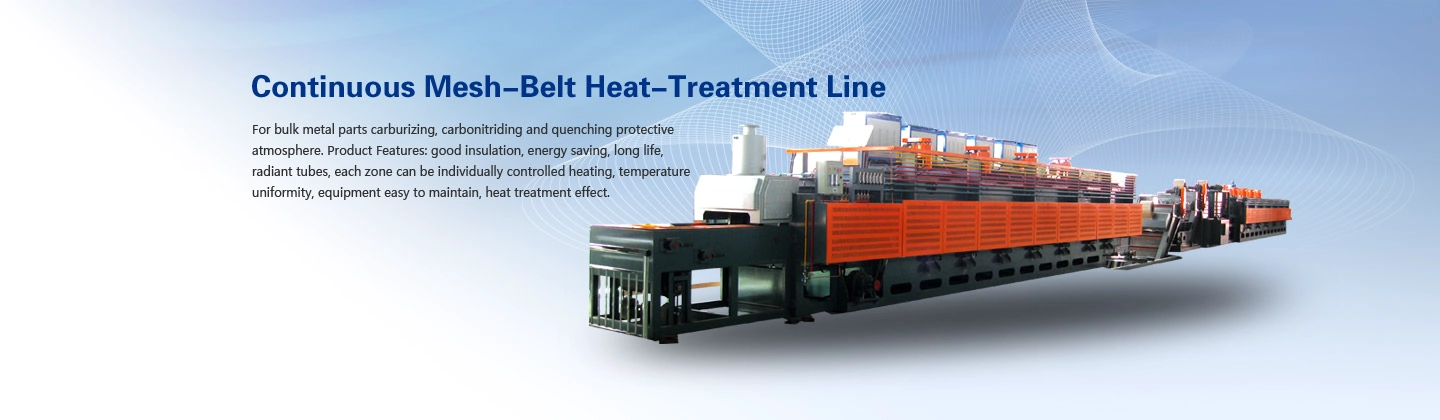
- Multi-Zone Heating: Modern mesh belt furnaces feature 6–12 independent heating zones (preheating, heating, soaking, quenching, tempering), each with its own PID controller and thermocouples. This allows precise tuning of temperature profiles for different fastener sizes and materials, achieving temperature uniformity of ±2.8°C (±5°F)—a 5x improvement over early models.
- Carbon Potential Control: Oxygen probes and real-time gas analyzers monitor and adjust the carbon potential of the protective atmosphere during carburizing and carbonitriding, ensuring consistent surface hardness and 渗层 depth (±0.05 mm). This eliminates oxidation and decarburization, critical for fasteners used in safety-critical applications.
- CFD Modeling: Computational Fluid Dynamics (CFD) simulations optimize internal furnace geometry, airflow patterns, and heat distribution, eliminating hot spots and ensuring uniform heating across the entire mesh belt.
2. Advanced Mesh Belt Design & Material Science
The mesh belt—the "workhorse" of the furnace—has undergone significant improvements in durability, load capacity, and design:
- High-Performance Alloys: Modern mesh belts are made of nickel-chromium-iron alloys (e.g., Inconel) or stainless steel with high chromium content, enabling continuous operation at 950°C+ with minimal oxidation and wear. These belts last 6–18 months in carburizing applications, compared to 3–6 months for early models.
- Precision Weave Design: Tighter, more uniform mesh weaving increases load capacity (up to 50 kg/m²) and ensures fasteners lie flat, preventing overlapping and uneven heating. Specialized belt designs (e.g., chain-driven, balanced weave) reduce friction and extend belt life.
- Soft Handling Features: Modern furnaces incorporate low-inertia transfers and external furnace loading to minimize fastener damage (e.g., thread stripping, surface scratches) during conveyance. This is critical for high-precision fasteners (e.g., aerospace bolts) that require flawless surfaces.
3. Full Automation & IoT Integration
Automation has been a game-changer for the fastener industry, reducing labor costs and human error while improving production efficiency. Modern mesh belt furnaces feature end-to-end automation and IoT-enabled smart controls:
- Automatic Loading/Unloading: Vibratory feeders, magnetic loaders, and robotic pick-and-place systems load fasteners onto the belt at a controlled rate, ensuring uniform distribution. Automatic unloaders sort and package finished fasteners, eliminating manual labor.
- PLC & HMI Systems: Programmable Logic Controllers (PLC) and user-friendly Human-Machine Interfaces (HMI) allow operators to program and store recipes for different fastener types, adjusting temperature, belt speed, and atmosphere settings with a single click.
- Remote Monitoring & Control: IoT connectivity enables real-time remote monitoring of furnace parameters (temperature, gas flow, belt speed) via smartphones or computers. Operators can adjust settings remotely, troubleshoot issues, and receive alerts for maintenance—reducing unplanned downtime by 40–60%.
- Data Traceability & Analytics: Integrated Manufacturing Execution System (MES) software logs all process data (temperature profiles, atmosphere composition, belt speed) for every batch of fasteners. This data is stored in the cloud for full traceability (required for ISO 9001 and IATF 16949) and analyzed to identify process inefficiencies and optimize production.
4. Energy Efficiency & Green Technology
Rising energy costs and global sustainability goals have driven the development of energy-efficient mesh belt furnaces that reduce fuel/electricity consumption and carbon emissions:
- Heat Recovery Systems: Recuperators and regenerative burners capture waste heat from the furnace exhaust and reuse it to preheat incoming air or gas, reducing energy consumption by 25–35%. Gas-powered mesh belt furnaces achieve up to 90% thermal efficiency, compared to 60–70% for early models.
- Advanced Insulation: High-performance ceramic fiber insulation reduces heat loss from the furnace walls, lowering energy consumption and improving workplace safety.
- Dual-Fuel Capability: Modern furnaces can switch between natural gas and electricity, allowing manufacturers to choose the most cost-effective and eco-friendly energy source based on availability and price.
5. Specialized Tempering & Inline Processing
Tempering is a critical step in fastener heat treatment, as it relieves quenching stresses and optimizes toughness. Recent advancements in tempering furnace design and inline processing have further improved fastener quality and production efficiency:
- Precision Tempering Systems: Advanced tempering furnaces feature forced air recirculation and multi-zone heating, achieving temperature uniformity of ±2.8°C (±5°F)—critical for high-strength fasteners (e.g., Grade 12.9 bolts) that require precise toughness and ductility.
- Inline Cleaning & Phosphating Removal: Integrated cleaning stations remove oil, quenching media, and zinc phosphate coatings from fasteners before tempering, ensuring clean surfaces and consistent tempering results. This eliminates the need for separate post-treatment cleaning, reducing production time and costs.