














Mesh Belt Furnaces – The Backbone of Modern Fastener Heat Treatment
Introduction
Fasteners—including bolts, nuts, screws, and rivets—are the unsung heroes of industrial manufacturing, holding together everything from automotive chassis and aerospace components to construction frameworks and electronic devices. For these small yet critical parts, mechanical reliability is non-negotiable: they must withstand extreme tensile stress, resist wear and fatigue, and maintain dimensional stability under harsh operating conditions. None of these properties are achievable through raw steel production alone—heat treatment is the transformative step that turns ordinary steel into high-performance fasteners.
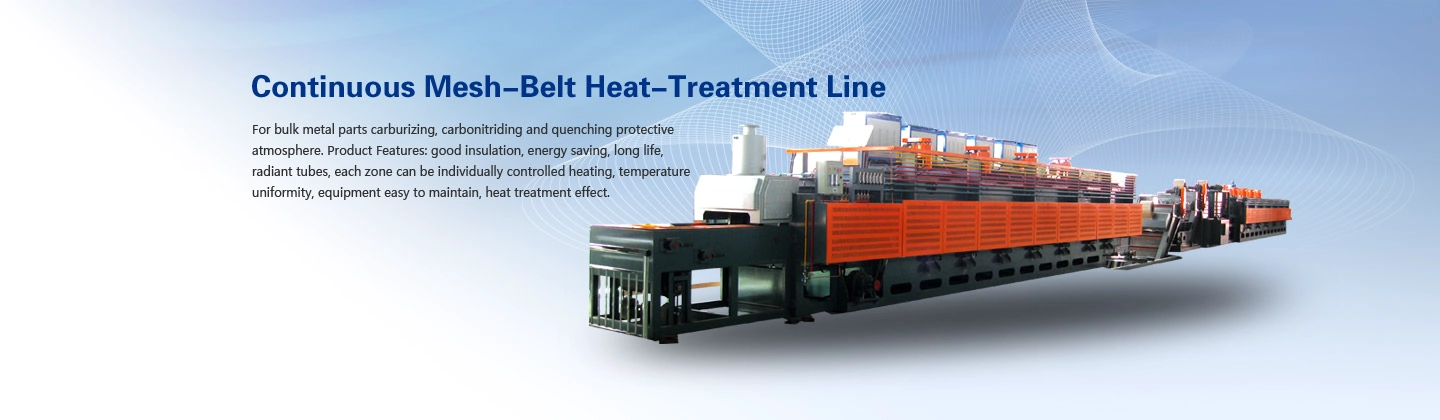
At the heart of this heat treatment revolution lies the mesh belt furnace, a continuous-processing industrial system that has become the gold standard for fastener manufacturing worldwide. Unlike batch furnaces, which process one load at a time and suffer from inconsistent heating, mesh belt furnaces enable high-volume, automated, and uniform heat treatment of millions of small fasteners with precise, repeatable results. This article explores the fundamental design, working principles, core processes, and key advantages of mesh belt furnaces in the fastener industry, revealing why they are indispensable for modern mass production.
What Is a Mesh Belt Furnace?
A mesh belt furnace is a type of continuous heat treatment equipment that uses a heat-resistant woven metal mesh belt (typically made of nickel-chromium alloy or stainless steel) as a conveyor to transport workpieces through a series of controlled heating and cooling zones. Designed specifically for small, high-volume components—fasteners being the primary application—these furnaces operate as integrated production lines, with minimal human intervention and maximum process consistency.
Core Structure & Components
A typical fastener-focused mesh belt furnace production line consists of five interconnected zones, each optimized for a specific stage of the heat treatment process:
- Loading & Pre-Cleaning Zone: Fasteners are automatically fed onto the mesh belt via vibratory feeders or magnetic loaders, ensuring uniform distribution (no overcrowding or gaps). A pre-cleaning station removes oil, grease, or metal debris from raw fasteners, preventing contamination in the high-temperature zone.
- Preheating Zone: Fasteners are gradually heated to 300–500°C to eliminate moisture and reduce thermal shock when entering the high-temperature zone. This step also improves energy efficiency by reducing the load on the main heating zone.
- High-Temperature Heating Zone: The heart of the furnace, where temperatures range from 840°C to 955°C (ideal for fastener hardening, carburizing, and carbonitriding). Multiple independent heating elements (electric resistance heaters or gas-fired burners) and PID controllers maintain temperature uniformity within ±5°C across the entire belt width, eliminating "hot spots" or "cold spots" that cause inconsistent hardness. A controlled protective atmosphere (endothermic gas, nitrogen, or hydrogen) circulates freely around each fastener, preventing oxidation and decarburization—critical for preserving surface quality and mechanical properties.
- Quenching Zone: After reaching the target temperature and soaking for a precise duration (determined by fastener size and material), fasteners are rapidly cooled in a quenching medium (oil, polymer solution, or water). The mesh belt’s continuous movement ensures every fastener experiences the exact same cooling rate, which is essential for forming a uniform martensitic microstructure (the key to high hardness and strength).
- Tempering & Unloading Zone: Quenched fasteners are reheated to 150–650°C in the tempering zone to relieve internal stresses, reduce brittleness, and optimize toughness and ductility. After tempering, fasteners are air-cooled, dried, and automatically unloaded for packaging or further processing (e.g., plating).
Working Principle: The Continuous Flow Advantage
The defining feature of a mesh belt furnace is its continuous-flow operation, which addresses the biggest challenge in fastener mass production: achieving consistent metallurgical properties across millions of individual parts.
Here’s a step-by-step breakdown of how it works:
- Continuous Conveyance: The mesh belt moves at a precise, adjustable speed (calibrated regularly to avoid errors), carrying fasteners through each zone in sequence. Every fastener spends the exact same amount of time in preheating, heating, quenching, and tempering—eliminating the batch-to-batch variability of traditional furnaces.
- Uniform Heating & Atmosphere Control: The woven mesh design allows hot air and protective gas to circulate freely around every fastener, even when densely packed. This ensures uniform heat absorption and prevents surface oxidation, which is critical for fasteners used in safety-critical applications (e.g., automotive brakes, aerospace assemblies).
- Precise Process Control: Modern mesh belt furnaces are equipped with IoT-enabled PLC systems and real-time monitoring sensors that track temperature, atmosphere composition (carbon potential), belt speed, and quenching parameters. Operators can adjust settings remotely, and all process data is logged for full traceability—a requirement for ISO 9001 and automotive quality standards (e.g., IATF 16949).