














Continuous Mesh Belt Furnace: The Core of Efficient, Precise Industrial Heat Treatment
In the global industrial heat treatment sector, the continuous mesh belt furnace has emerged as an indispensable core equipment, driving the transformation of mass production with its continuous operation, high precision, and energy-saving advantages. As industries such as automotive, fasteners, electronics, and powder metallurgy pursue higher efficiency, better product consistency, and greener production, traditional batch-type heat treatment equipment can no longer meet the demands of large-scale, standardized production. The continuous mesh belt furnace, with its integrated design of automated conveying, precise temperature control, and flexible atmosphere adjustment, has become the preferred choice for enterprises aiming to optimize heat treatment processes, reduce costs, and enhance product competitiveness. According to data from the China Heat Treatment Industry Association, the domestic continuous heat treatment equipment market reached 8.6 billion yuan in 2024, with mesh belt furnaces accounting for more than 35%, and the segment is expected to exceed 10 billion yuan by 2026.
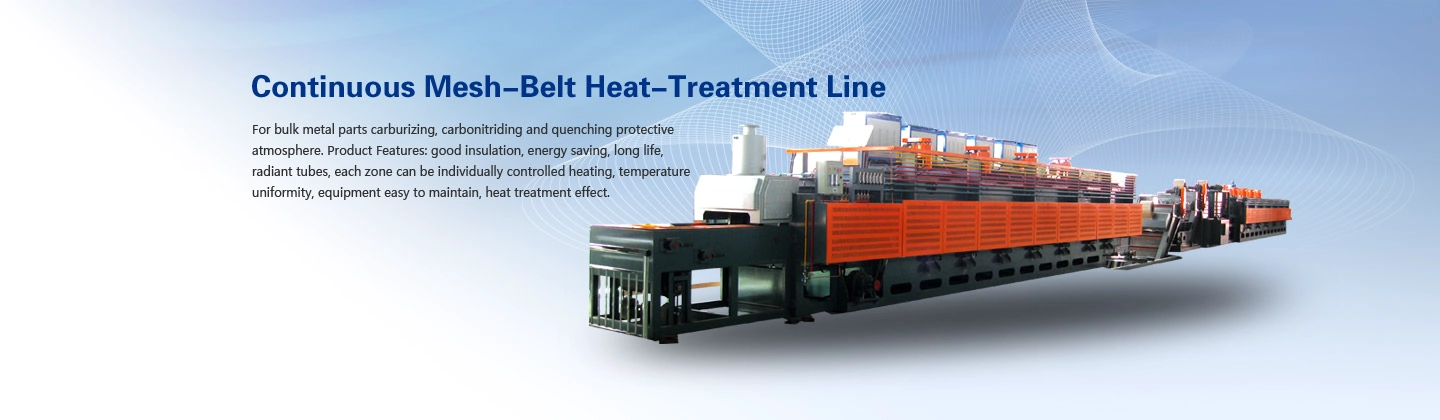
A continuous mesh belt furnace is a specialized industrial heat treatment device that uses a heat-resistant metal mesh belt as the conveying carrier to realize continuous and automated processing of workpieces. Unlike intermittent furnaces that require repeated loading, heating, cooling, and unloading, this equipment allows workpieces to pass through preheating, constant temperature, and cooling zones in sequence with the operation of the mesh belt, completing heat treatment processes such as annealing, quenching, brazing, sintering, and tempering in one continuous flow. Its core advantage lies in breaking the inefficient cycle of traditional equipment, achieving 24/7 uninterrupted operation, and ensuring that every workpiece receives consistent thermal treatment, which is crucial for improving production efficiency and product quality stability.
What is a Continuous Mesh Belt Furnace?
The continuous mesh belt furnace is a continuous heat treatment equipment widely used in metal processing, non-ferrous metals, ceramics, and building materials industries, designed to handle large-volume, small-to-medium-sized workpieces with uniform heating requirements. Its main structure consists of five core parts: mesh belt transmission system, heating system, temperature control system, cooling system, and exhaust system, each of which works together to ensure stable and efficient operation. The mesh belt, the core of the conveying system, is made of heat-resistant alloys such as 314 and 310S, with adjustable aperture and thickness according to workpiece weight and temperature requirements to ensure stable conveying and uniform heating.
Based on heating methods, continuous mesh belt furnaces are mainly divided into electric heating mesh belt furnace and gas heating mesh belt furnace. Electric heating models use electric heating tubes as heating elements, suitable for scenarios with high process requirements, while gas heating models use natural gas or liquefied gas as fuel, offering cost-saving advantages for large-scale production. Additionally, according to atmosphere requirements, they can be configured with protective atmosphere systems (such as nitrogen-hydrogen mixture, ammonia decomposition, or pure nitrogen) to achieve bright heat treatment without oxidation or decarburization, ensuring excellent surface finish of workpieces.
Core Working Principle & Process
The working principle of a continuous mesh belt furnace is centered on continuous and uniform thermal processing, with the mesh belt serving as the key carrier to drive workpiece movement through each functional zone. The entire workflow is fully automated, reducing human intervention and ensuring consistent process repeatability. The specific process can be divided into five key stages:
-
Automatic Feeding & Mesh Belt Conveying: Workpieces are evenly placed on the mesh belt through a feeding device (hopper or stainless steel tray), and the mesh belt runs at an adjustable speed (0.1–1.5 m/min) driven by a servo motor, transporting workpieces stably through each processing zone. The mesh belt speed can be flexibly adjusted to control the residence time of workpieces in the furnace, adapting to different heat treatment process requirements.
-
Preheating Zone: Workpieces enter the preheating zone first, where they are gradually heated to the preset temperature to avoid damage caused by sudden temperature changes. This stage also helps remove moisture and volatile substances from the workpiece surface, laying the foundation for subsequent high-temperature processing.
-
Constant Temperature Heating Zone: This is the core part of the heat treatment process. The furnace temperature is precisely controlled within the range of 600–1150℃, with a temperature control accuracy of ±1–3℃, achieved through a closed-loop control system composed of thermocouples, intelligent PID regulators, and thyristors. Heating elements (electric or gas) around the furnace chamber generate heat, and mechanical convection fans ensure uniform heat distribution, so that every surface of the workpiece is exposed to the same temperature conditions.
-
Cooling Zone: After completing the high-temperature process, workpieces enter the cooling zone, where they are cooled to room temperature through natural cooling, forced air cooling, or water cooling, depending on the workpiece material and process requirements. This stage avoids workpiece deformation or cracking caused by rapid cooling, ensuring the structural stability of the finished product.
-
Automatic Discharging & Collection: Cooled workpieces are automatically discharged from the mesh belt and collected centrally, which can be seamlessly connected to subsequent processing lines such as surface plating, packaging, or tapping, forming a complete production line.
Key Advantages of Continuous Mesh Belt Furnaces
1. High Production Efficiency & Large Throughput
The biggest advantage of continuous mesh belt furnaces is their continuous operation capability, which eliminates the downtime caused by loading and unloading in batch furnaces. High-performance models can achieve 24/7 uninterrupted operation, with a processing capacity far exceeding that of traditional intermittent equipment. For example, in fastener heat treatment, the processing speed can reach hundreds of pieces per minute, significantly shortening production cycles and improving order fulfillment capabilities for large-scale orders.
2. Excellent Temperature Uniformity & Product Consistency
Equipped with a high-precision temperature control system and uniform heat circulation design, continuous mesh belt furnaces ensure that the temperature difference in the furnace chamber is within ±10℃, and the temperature control accuracy reaches ±1–3℃. This ensures that every workpiece, from the first to the ten-thousandth, receives the same thermal treatment, effectively avoiding quality inconsistencies caused by manual operation or uneven heating, and improving product qualification rates.
3. Energy Saving & Environmental Protection
Modern continuous mesh belt furnaces adopt lightweight and efficient insulation materials, which reduce heat loss and lower the ambient temperature of the workshop. Compared with traditional box-type furnaces, their energy consumption is reduced by more than 20%. Additionally, the exhaust system effectively discharges waste gas and water vapor generated during the heating process, reducing environmental pollution. Some advanced models are also equipped with waste heat recovery systems, further improving energy utilization efficiency.
4. Wide Adaptability & Versatility
Continuous mesh belt furnaces can handle a variety of materials, including low-carbon steel, stainless steel, alloy steel, copper alloys, and powder metallurgy materials, and are suitable for multiple heat treatment processes such as bright annealing, quenching, tempering, brazing, and sintering. They can process small-to-medium-sized workpieces such as fasteners, bearings, springs, gears, electronic components, and powder metallurgy parts, meeting the diversified needs of different industries.
5. Intelligent Operation & Easy Maintenance
Most industrial-grade continuous mesh belt furnaces are equipped with PLC central control systems and touch-screen human-machine interfaces, allowing operators to quickly adjust parameters such as mesh belt speed, furnace temperature, and heating time. Advanced models also have real-time monitoring, fault alarm, and process parameter recording functions, which reduce downtime and lower the technical threshold for operation. The modular design of the equipment also facilitates daily maintenance and parts replacement, extending the service life of the furnace.
Main Applications of Continuous Mesh Belt Furnaces
As a core heat treatment equipment, the continuous mesh belt furnace is widely used in various industrial fields that require mass, high-precision heat treatment, covering automotive, fasteners, electronics, powder metallurgy, and other key industries:
-
Automotive & Auto Parts Industry: Heat treatment of engine parts, chassis fasteners, gears, bearings, and brake components, improving their hardness, wear resistance, and fatigue resistance.
-
Fastener & Hardware Industry: Bright annealing, quenching, and tempering of bolts, nuts, washers, and chains, ensuring product strength and surface finish while meeting international standards such as DIN and ISO.
-
Electronics Industry: Heat treatment of electronic components, semiconductor materials, and battery materials, including pre-firing, firing, and brazing, ensuring the stability and reliability of electronic products.
-
Powder Metallurgy Industry: Sintering of powder metallurgy parts such as oil-impregnated bearings and gears, realizing the combination of powder particles into dense workpieces with excellent mechanical properties.
-
Other Industries: Heat treatment of ceramic materials, catalysts, molecular sieves, and activated carbon, as well as drying and calcination of granular materials, adapting to the needs of new energy, chemical, and other emerging industries.
Key Considerations When Choosing a Continuous Mesh Belt Furnace
For enterprises planning to invest incontinuous mesh belt furnaces, selecting equipment that matches their actual production needs is crucial to maximizing investment returns. Here are the key factors to consider:
-
Temperature Range: Choose the appropriate temperature range (600–1150℃) according to the heat treatment process requirements. For example, high-temperature sintering requires a furnace with a maximum temperature of 1150℃, while ordinary annealing can use a medium-temperature model.
-
Mesh Belt Specifications: Select the mesh belt width, material, and speed according to the size, weight, and processing volume of the workpiece. Heat-resistant alloys such as 310S are suitable for high-temperature environments, while ordinary stainless steel is suitable for medium and low temperatures.
-
Atmosphere Configuration: If bright heat treatment or non-oxidation treatment is required, choose a furnace equipped with a protective atmosphere system, and confirm that it can configure the appropriate gas mixture (such as nitrogen-hydrogen ratio) to avoid decarburization or oxidation of workpieces.
-
Energy Efficiency & After-Sales Service: Prioritize equipment with energy-saving designs (such as waste heat recovery) to reduce long-term operating costs. At the same time, choose suppliers with complete after-sales support, including installation training, spare parts supply, and maintenance services, to ensure stable long-term operation of the equipment.
-
Production Capacity: Match the equipment's processing capacity with the daily order volume to avoid insufficient capacity or waste of resources. For large-scale production, choose high-speed models with large mesh belt widths, while small and medium-sized enterprises can choose cost-effective standard models.
Industry Trends & Conclusion
With the global industrial transformation towards intelligence, greenization, and high precision, the continuous mesh belt furnace industry is also evolving in the direction of intelligence, high efficiency, and customization. The latest models integrate intelligent control technologies such as IoT and big data, realizing real-time monitoring of furnace temperature, mesh belt speed, and atmosphere composition, as well as remote operation and fault diagnosis. At the same time, the development of new heat-resistant materials and energy-saving technologies is further improving the energy efficiency and service life of the equipment, meeting the global requirements for green production.
In conclusion, the continuous mesh belt furnace is not only a key equipment for industrial heat treatment but also a core driving force for enterprises to improve production efficiency, ensure product quality, and enhance market competitiveness. Its continuous operation, high precision, energy saving, and versatility make it an indispensable part of modern manufacturing production lines. As industries continue to upgrade, the demand for high-performance continuous mesh belt furnaces will continue to grow, and it will play a more important role in promoting the high-quality development of the heat treatment industry and related fields.