















Heat Treatment Furnace: Types, Benefits and Modern Industry Applications in 2026
A heat treatment furnace is a core industrial thermal processing device designed to heat, hold, and cool metal workpieces under precisely controlled temperature and atmospheric conditions. It is indispensable in metallurgy, machinery manufacturing, automotive, aerospace, and tool processing industries. Unlike ordinary industrial heating equipment, a professional industrial heat treatment furnace focuses on accurate metallurgical transformation, improving the mechanical properties of metal materials such as hardness, toughness, ductility, and wear resistance while ensuring stable and repeatable processing results.
With the upgrading of intelligent manufacturing and stricter industrial quality standards in 2026, high-precision, energy-saving, and environmentally friendly heat treatment furnace solutions have become the mainstream choice for modern manufacturing enterprises. Optimized furnace design and intelligent temperature control systems not only improve product qualification rates but also reduce production costs and carbon emissions, helping factories meet sustainable production requirements.
Core Working Principle of Industrial Heat Treatment Furnace
The working logic of a modern heat treatment furnace is based on standardized metallurgical heat treatment processes. The equipment completes the full closed-loop process of heating, constant-temperature holding, and staged cooling by adjusting internal temperature, heating time, and protective atmosphere. Through precise thermal cycle control, the internal microstructure of metal materials is reasonably transformed, eliminating internal stress generated during forging, casting, and machining.
High-quality industrial heat treatment furnaces strictly comply with industry standards such as AMS 2750, realizing ultra-high temperature uniformity and stable atmosphere control. This effectively avoids workpiece oxidation, decarburization, and thermal deformation, ensuring consistent quality of each batch of processed parts, which is the key to mass industrial standardized production.
Main Types of Heat Treatment Furnace and Application Scenarios
According to production methods, structural forms, and process uses, heat treatment furnaces on the market are mainly divided into multiple categories, adapting to different production volumes, workpiece specifications, and process requirements:
1. Batch Type Heat Treatment Furnace
Batch furnaces are suitable for small and medium-batch, multi-variety production scenarios, with flexible operation and strong adaptability. Common types include box-type heat treatment furnaces, pit-type furnaces, and bell-type furnaces. They are widely used for annealing, normalizing, quenching, and tempering of small-batch molds, tool steels, and mechanical parts. Featuring simple structure and low equipment investment, they are the preferred equipment for small and medium-sized processing enterprises.
2. Continuous Heat Treatment Furnace
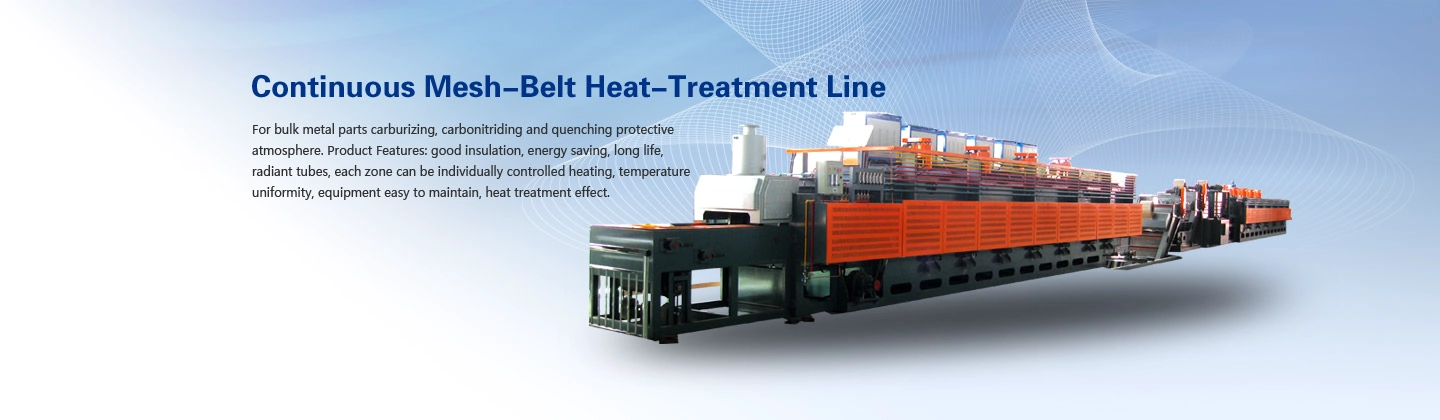
Continuous furnaces such as roller hearth furnaces and mesh belt furnaces support uninterrupted assembly line production. With high automation and stable processing efficiency, they are suitable for large-scale standardized production of automotive parts, fasteners, and hardware accessories. The whole production process is automatically controlled, which greatly reduces manual intervention and improves production consistency and efficiency.
3. Vacuum Heat Treatment Furnace
As a high-end industrial heat treatment device, vacuum heat treatment furnaces perform heating and quenching in a vacuum environment. They completely avoid workpiece oxidation and decarburization, and are widely used in aerospace precision parts, medical equipment parts, and high-end tool steel processing. Equipped with low-pressure carburizing and high-pressure gas quenching technology, it can achieve high-precision, high-quality surface heat treatment and is an essential core equipment for high-end manufacturing.
Key Advantages of Modern Heat Treatment Furnace
Compared with traditional old-fashioned heating equipment, the upgraded industrial heat treatment furnace in 2026 has obvious comprehensive advantages in energy saving, precision, safety and intelligence:
-
Precise Temperature Control: Adopting intelligent PLC temperature control system, the temperature control accuracy can reach ±1℃, with uniform furnace temperature, effectively ensuring the stability of metal heat treatment quality and reducing product defective rate.
-
Energy Saving and Environmental Protection: Optimized furnace lining insulation structure and efficient heating components greatly reduce heat loss. Meanwhile, it is matched with low-consumption atmosphere control technology, reducing gas and power consumption, and meeting industrial energy-saving and emission reduction standards.
-
High Safety and Stability: Equipped with emergency shutdown, over-temperature protection, and airtight safety protection devices, it avoids safety risks such as overheating and air leakage during equipment operation, ensuring safe and stable long-term operation.
-
Intelligent Operation: Support one-key setting of heat treatment process parameters, automatic recording of processing data, and remote monitoring. It realizes digital management of heat treatment production and facilitates production traceability and process optimization.
2026 Industry Trends of Heat Treatment Furnace
With the rapid development of intelligent manufacturing and green industry, the heat treatment furnace industry is presenting three major development trends. First, intelligent upgrading, more equipment realizes automatic process matching and intelligent fault diagnosis, reducing manual operation difficulty. Second, green energy conservation, low-carbon and high-efficiency furnace body design and clean heat treatment processes gradually replace traditional high-energy-consumption equipment. Third, high-precision customization, targeted customized furnace solutions for special materials and special process requirements have become popular in the market.
In high-end manufacturing fields such as new energy vehicles, aerospace, and precision machinery, the demand for high-performance vacuum heat treatment furnaces and automated continuous heat treatment lines is growing rapidly, which will further drive the technological iteration and market upgrading of the industry.
How to Choose a Suitable Industrial Heat Treatment Furnace
Enterprises need to comprehensively consider multiple factors when selecting a heat treatment furnace. First, match the equipment type according to production batch and workpiece type: choose batch furnaces for multi-variety and small-batch production, and continuous furnaces for large-scale standardized production. Second, select targeted equipment according to heat treatment processes such as annealing, quenching, tempering, and carburizing. Third, focus on equipment temperature uniformity, energy consumption indicators, and after-sales service to ensure long-term stable production and reduce comprehensive operating costs.
Final Words
As a key equipment to improve metal material performance, the heat treatment furnace runs through the entire industrial manufacturing chain. With the continuous progress of industrial technology, modern heat treatment furnaces are developing towards higher precision, higher efficiency, lower energy consumption and greater intelligence. For manufacturing enterprises, selecting high-quality industrial heat treatment furnace equipment is not only the basis for ensuring product quality, but also an important measure to enhance core market competitiveness in the fierce industrial competition.