















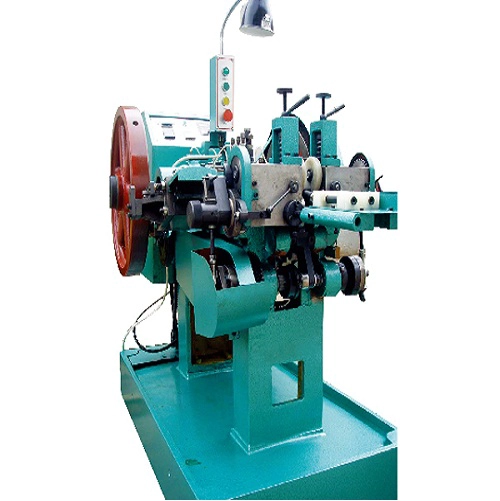
Working Principle and Advantages of a 1-Die 2-Blow Heading Machine for Screws
A 1-die 2-blow heading machine is a fundamental type of cold heading equipment used for manufacturing screws, bolts, and other fasteners. It is designed for high-speed production of simpler head styles and represents a balance between efficiency and machine complexity.
Working Principle
The process is based on cold forming, where a metal wire is shaped at room temperature using extreme pressure. The term "1-die 2-blow" describes the machine's core mechanism: it uses a single die and two hammering actions (blows) to form the head of the screw.
The operational sequence is as follows:
Wire Feeding and Cutting: A coil of metal wire is fed into the machine. A gripper mechanism advances a precise length of wire, which is then sheared off by a cutter to create a blank or slug. The volume of this slug is calculated to match the volume of the final screw head.
Transfer to Die: The cut blank is transferred and positioned in front of the single, stationary die.
First Blow: A punch (or hammer) strikes the end of the blank, pushing it into the die cavity. This first impact begins the upsetting process, gathering the material and forming a preliminary, rough shape of the head.
Second Blow: A second punch, often with a slightly different face, strikes the partially formed head. This second blow completes the forming process, pressing the metal into the final shape and dimensions of the die cavity. This creates the finished head, including features like the bearing surface and head height.
Ejection: The finished screw blank is then ejected from the die, ready for the next manufacturing stage, such as thread rolling.
Key Advantages
The 1-die 2-blow heading machine offers several distinct benefits, making it a popular choice for many standard fastener applications:
High Production Speed: These machines are capable of operating at extremely high speeds, often producing hundreds of parts per minute. This makes them ideal for the mass production of high-volume items.
Material Efficiency: As a cold forming process, it displaces metal rather than cutting it away. This results in virtually no material waste, which is a significant cost-saving advantage, especially with expensive materials.
Improved Mechanical Strength: The cold working process aligns the metal's grain structure to follow the shape of the screw head. This enhances the part's strength, durability, and resistance to fatigue compared to parts made by machining.
Simplicity and Cost-Effectiveness: Compared to multi-die machines, the 1-die 2-blow design is mechanically simpler. This often translates to lower initial machine costs, easier maintenance, and simpler operation.
Excellent Surface Finish: The process produces parts with a smooth surface finish directly from the machine, often eliminating the need for additional finishing operations.
Suitability for Standard Heads: This machine is perfectly suited for producing common and relatively simple head styles, such as pan heads, round heads, flat heads, and hex heads.