














How Industrial Heat Treatment Furnaces Ensure Quality and Consistency in Fastener Manufacturing
In fastener manufacturing, cold forming gives a bolt or screw its dimensional shape, but heat treatment determines its mechanical soul. For high-tensile bolts, self-tapping screws, and precision industrial components, a reliable heat treatment furnace is the critical line between a standard part and a high-performance, certified fastener.
As global quality standards become more stringent, understanding the operation and selection of heat treatment equipment is essential for modern plant managers and technical procurement teams.
The Crucial Role of Continuous Heat Treatment in Fasteners
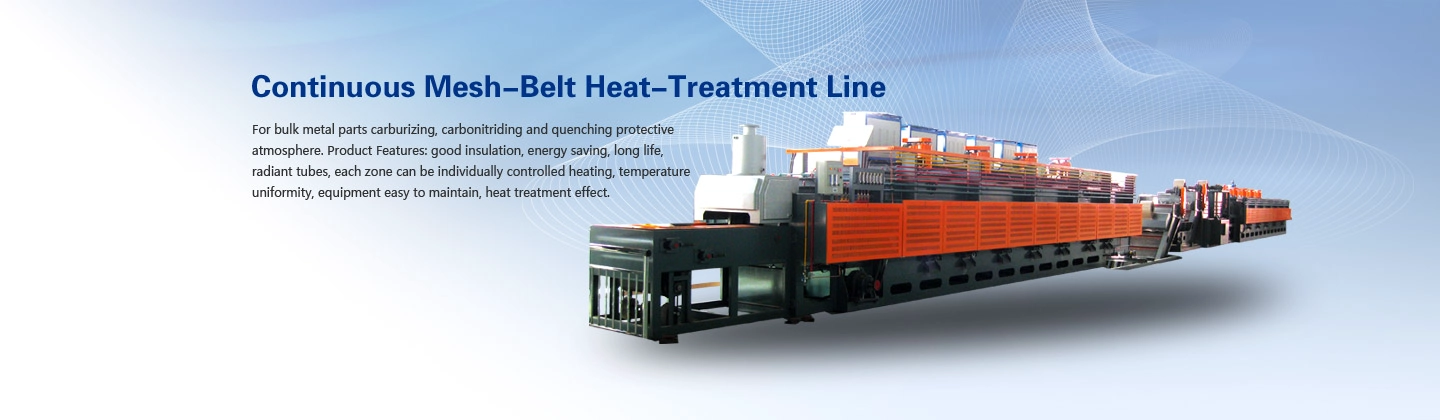
Unlike general batch heating, fastener production demands high throughput, tight temperature uniformity, and minimal surface decarburization. Continuous mesh belt furnaces have become the industry standard for processing mass-produced fasteners.
- Quenching & Hardening: Parts are uniformly heated above their critical austenitizing temperature in a controlled protective atmosphere, followed by rapid quenching (usually in oil or specialized polymer solutions) to achieve a high-hardness martensitic structure.
- Carburizing & Carbonitriding: For self-drilling screws and case-hardened components, introducing precise carbon and nitrogen potentials into the furnace atmosphere produces a wear-resistant surface layer while maintaining core ductility.
- Tempering: Re-heating the quenched parts to precise lower temperatures relieves internal stress, balances hardness, and achieves the exact target tensile strength and elongation required by international standards (such as ISO 898-1 or ASTM specifications).
Key Criteria When Evaluating a Fastener Heat Treatment Line
When upgrading or investing in a new heat treatment line, evaluate the following engineering aspects beyond rated capacity alone:
- Atmosphere Control and Gas Tightness: An advanced protective atmosphere control system (using methanol, cracked ammonia, or nitrogen-methanol systems) is vital to eliminate surface oxidation and control surface carbon levels with tight tolerance.
- Temperature Uniformity Across Zones: Multi-zone PID temperature controls ensure consistent thermal transfer from the inlet to the soaking zone, avoiding batch-to-batch hardness variations.
- Energy Efficiency and Thermal Insulation: High-density ceramic fiber linings, optimized burner layouts, or high-efficiency electric elements significantly reduce power/gas consumption per ton of processed steel.
- Continuous Automation Integration: Modern lines integrate seamlessly with automatic weigh-loading systems, pre-wash stations, post-washers, and continuous drying units, reducing labor dependency and human error.
Moving Toward Smarter, Traceable Thermal Processing
Consistency is the benchmark of modern metallurgical processing. Modern continuous furnace lines now incorporate digital data logging for each heat-treating batch—recording temperature curves, atmosphere potential, and belt travel speeds. This traceability is essential for automotive, aerospace, and critical structural applications.
Whether you are producing grade 8.8, 10.9, or 12.9 structural bolts, selecting the right furnace configuration tailored to your material grades and output requirements is the most direct path to zero-defect manufacturing.